
A team shapes each agent
Several people edit one agent within their roles, as drafts; nothing reaches customers until a version is made Live.
Agent Studio
Everyone who knows your business shapes the same agents: each person owns their part, drafts are reviewed, and one version goes Live. Then the agents pass work to each other in workflows.
In a private pilot with a small number of companies. Read our Privacy Policy.
Inside an agent
Think of it as a new team member your whole team trains together.
A service agent sits in the middle, with its versions: Draft, Dev and Live. Only Live answers people. Nine parts slot into it, one at a time:
When every part is in, Publish runs the checks, they pass, and the agent moves from Draft to Dev to Live.
People across the company shape the same agent, each in the part they know best. Then one agent can answer as many of your people and places.
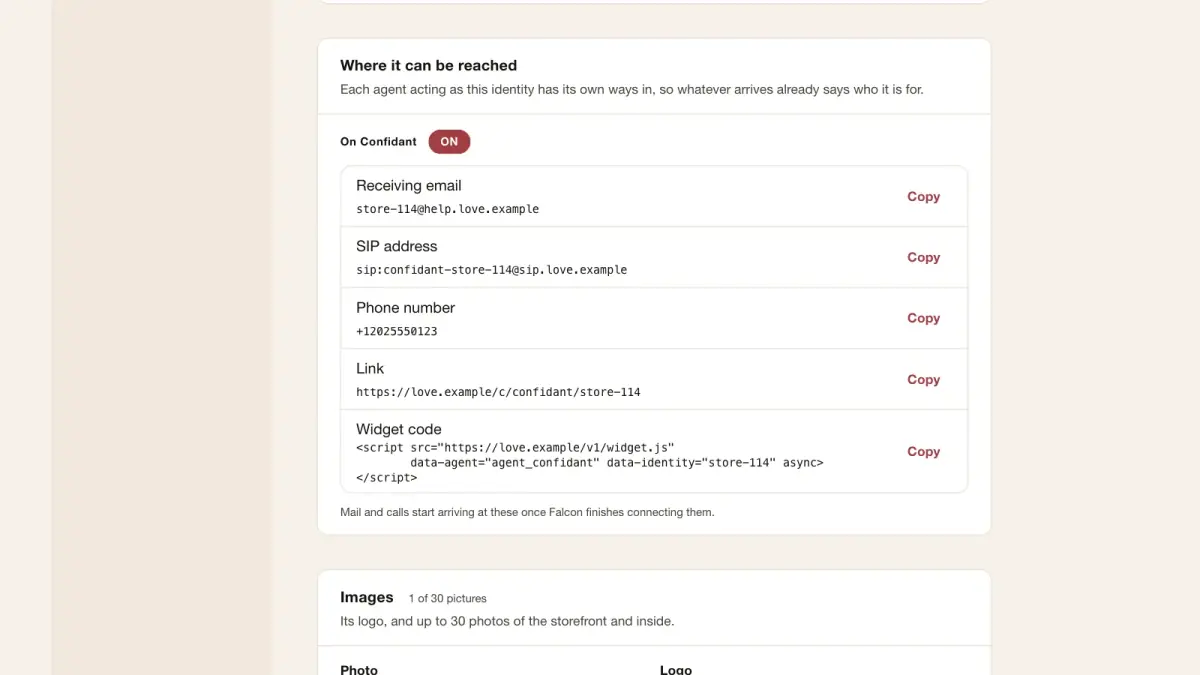
Each identity gets its own addresses, any system can send its requests through a request map, and the apps you connect can start work. Whatever arrives already says who it is for.
One agent, the Front desk, acts for two identities: Dr. Rivera, a person, and the Downtown store, a place. Each identity has its own set of addresses, drawn as cards: a receiving email such as k7f3q9xm@falcon.com, a SIP address, a phone number marked optional, a public link and a website chat snippet. A new email arrives at Dr. Rivera's address, the message runs up to Dr. Rivera, and the agent shows Acting as Dr. Rivera. Then a call arrives at the Downtown store's SIP address and the agent acts as the Downtown store. Whatever arrives already says who it is for.
A POST request arrives with a signature header and a JSON body with four fields: called_number, caller_phone, recording_url and plan. The signature is checked first. Then arrows carry each field into the request map in turn: recording_url becomes the start field recording; called_number looks up the identity the agent acts as, the Downtown store; caller_phone matches the customer; plan becomes a custom field; and the identity is sent on as the Falcon-Identity header. A fixed value is typed into the map: topic equals Call report. The map feeds a workflow whose first stage has two steps side by side, Summarise and Update CRM, both receiving the same start fields. The caller gets back 202 Accepted with a run ID.
Connected apps are drawn as tiles, each with a line into one workflow and its agent. Gmail and Google Calendar, a new email or an event coming up, marked Yours because the account belongs to one person. HubSpot and Salesforce, when a CRM record changes, marked Company. GitHub, on a push, pull request or issue, marked Company. Slack, a message in a channel, marked Company. A schedule, every weekday at 9:00. Another workflow, when it finishes. Your own systems, sending an event such as order.refunded, which waits for approval before it can start work. Outlook mail and calendar and Microsoft Teams are marked coming next. In turn, each live tile lights, a message runs along its line, and the workflow shows what started it. The event from your own systems first changes from Needs approval to Approved.
People reach your agents the way they already talk: email, calls, texts, chat, apps and messaging.
Each agent and identity gets its own address, and people write to it as they would to anyone.
People call, and the agent answers in a voice of its own.
Text messages to and from your company’s own numbers.
Branded messages with your logo and name, from a sender the carriers approve.
A chat window on your site, from one snippet you paste in.
A page anyone can open to talk to the agent.
The same chat window, inside your own app.
Agents send and receive messages there through messaging tools.
Messages on WhatsApp, as with texts.
Email, webhooks and EventBridge events all run through the request mapper: body fields, headers and fixed values become start fields, the identity to act as, and the customer.
Order confirmations, alerts and forms that arrive by email start work.
Any system can send a signed request, and your systems hear back when a run finishes.
For companies running Falcon in their own AWS account: events from that account start work, privately. Everyone else sends the same events as signed webhooks.
A workflow is your team’s playbook. Agents hand work to each other, side chains start on their own, and people step in only where you ask.
Sometimes each side of a deal has its own agent, such as a dealership buying leads and a lead source selling them. The agents never talk directly: they negotiate through a Falcon clean room that passes on only what both sides agreed to share.
Each step starts when the one before it finishes.
A step splits into two that run together, then they join again.
A check sends the work one way or the other, such as open or after hours.
A signal, such as “wants a call”, starts extra steps while the main line carries on.
Pauses for a set time, or for a person to approve, then carries on.
Runs steps again, such as a follow-up every few days, until someone replies or a limit is reached.
The next person or identity in the rotation handles it.
Two parties’ agents negotiate through a clean room; each side sees only what’s agreed, and contact details stay private until both say yes.
Start a new agent from a base your company already trusts. It keeps the base's locked rules, and your team shares skills and access instead of starting over.
Agencies that build AI employees for their clients can run every client on Falcon. Publish your base agents, skills and tools once, and each client builds on them under your brand.
Anything can start a workflow. The agents call your systems, and each agent remembers only what you allow.
Every message, file and script gets quick checks from jev by TypeSafe, a small, fast model that answers yes/no, pick-one or score questions about a piece of text with a confidence, in a fraction of a second and at a tiny cost. Code makes the final decision, and anything uncertain goes to a person.
A person’s or place’s details are checked for instructions to the agent, sensitive data and abuse when saved or imported.
LiveEvery script and tool call is checked for risky or irreversible steps, such as a force push.
Coming nextAn independent check, not the agent grading itself, decides when a side chain starts.
Coming nextFiles and GitHub pull requests are checked for secrets, personal data, hidden instructions and duplicates.
Coming nextThey ask one question across a repository and read only the files that matter.
Coming nextAgents ask a question about documents without loading them into the conversation.
Coming nextA check spots when a long conversation can be summarised, and never in the middle of a task.
Coming nextjev never decides alone: code has the last word, a confident answer never grants permission, sensitive checks hold when jev is unavailable, and every decision is recorded.
AI teammate products are finished and easy, but built for a team’s own work. AgentCore is the secure, scalable platform, but you have to build the agents. Companies that want customer-facing agents have had to pick one and live without the other. Falcon sits in the middle.
Finished product
Falcon bridges the gap
Platform to build on
Named agents you shape in plain words, starters for common jobs, Ask Falcon to help, and nothing to code or host.
Every Falcon agent runs on AgentCore: isolated sessions, managed memory, identity and tool gateway, observability and scale, in Falcon’s AWS account or the company’s own.
Many people configuring the same agents with roles, drafts and a Live version; identities with consent and their own numbers and addresses; every channel with replies routed to the right agent; approvals, spend limits and reports; and all of it on MCP.
A company gets customer-facing agents working in days, without building a platform and without giving up control of its data, its spend or what gets sent.
Several people edit one agent within their roles, as drafts; nothing reaches customers until a version is made Live.
One agent can speak as Dana, the Downtown store or Riverside, each with its own email, number, hours, voice and consent. Identities never sign in to Falcon.
Texts, RCS, email, calls and chat. A reply always finds the right agent and identity, even across channels, and follow-ups only go where the person agreed.
Drafts wait for approval, agents ask an admin when unsure, and risky actions need confirmation. Nothing is sent that shouldn’t be.
Small yes/no and routing decisions use a model built for calibrated answers, with the probability recorded, so they are cheap, fast and auditable.
Anything you can do in Falcon, an AI assistant can do through MCP within your access, by design and checked on every build.
Agents run in AWS, and a company can choose its own AWS account. Reports show counts and cost, never what people said.
Limits, reservations and kill switches on every agent and workflow, so a runaway loop can’t run up a bill.
Some of these run today. The ones marked Coming next are designed and on the way, but not built yet.
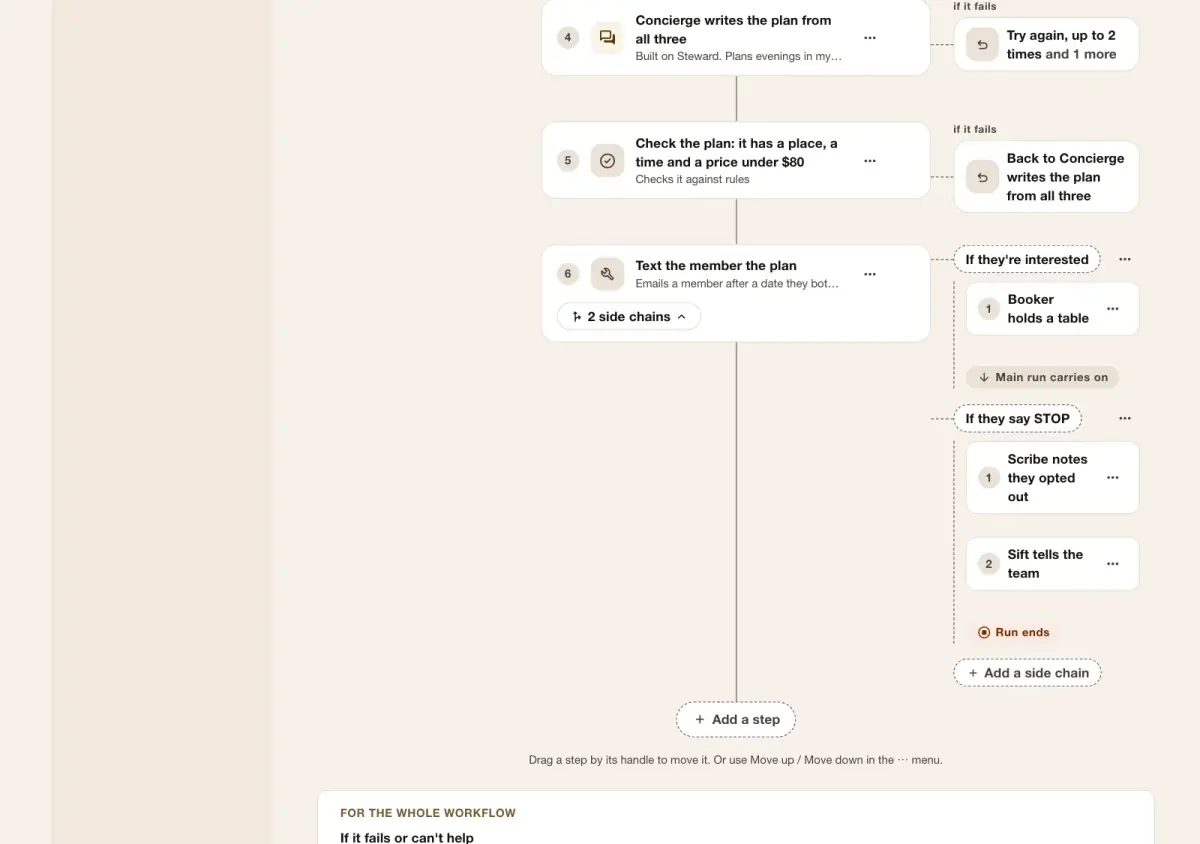
Love’s Confidant plans dates with members: a researcher, a planner and a booker work at once, a check makes sure the plan is complete, and the plan is texted back.
The Downtown store has its own number, hours and voice. Calls outside hours go to an AI voicemail that takes a message and starts a follow-up.
One agent greets, looks the person up in past conversations and the CRM, then hands to the sales or service agent.
A new email to a mailbox gets a drafted reply that waits in Waiting for you until someone sends, edits or drops it.
A finished Twilio, Zoom or RingCentral recording becomes a transcript, a summary with follow-ups, and a note on the caller’s history.
New leads rotate between reps who are available, and each customer keeps their rep for later conversations.
An agent makes changes and commits to GitHub as the identity it acts for, with the requester credited.
Agents answer from help articles and policies you upload or connect, and say when they don’t know.
Messages carry topics, replies route by keyword or content, and opting out of marketing never stops order updates.
Screens from Falcon as it is built today, running on example data in one pilot company’s colours. See every feature, and which are live.
Falcon is in a private pilot. Tell us about your team and we’ll be in touch.
Sign up